 Image 1 of 1
Key Sound Characteristics
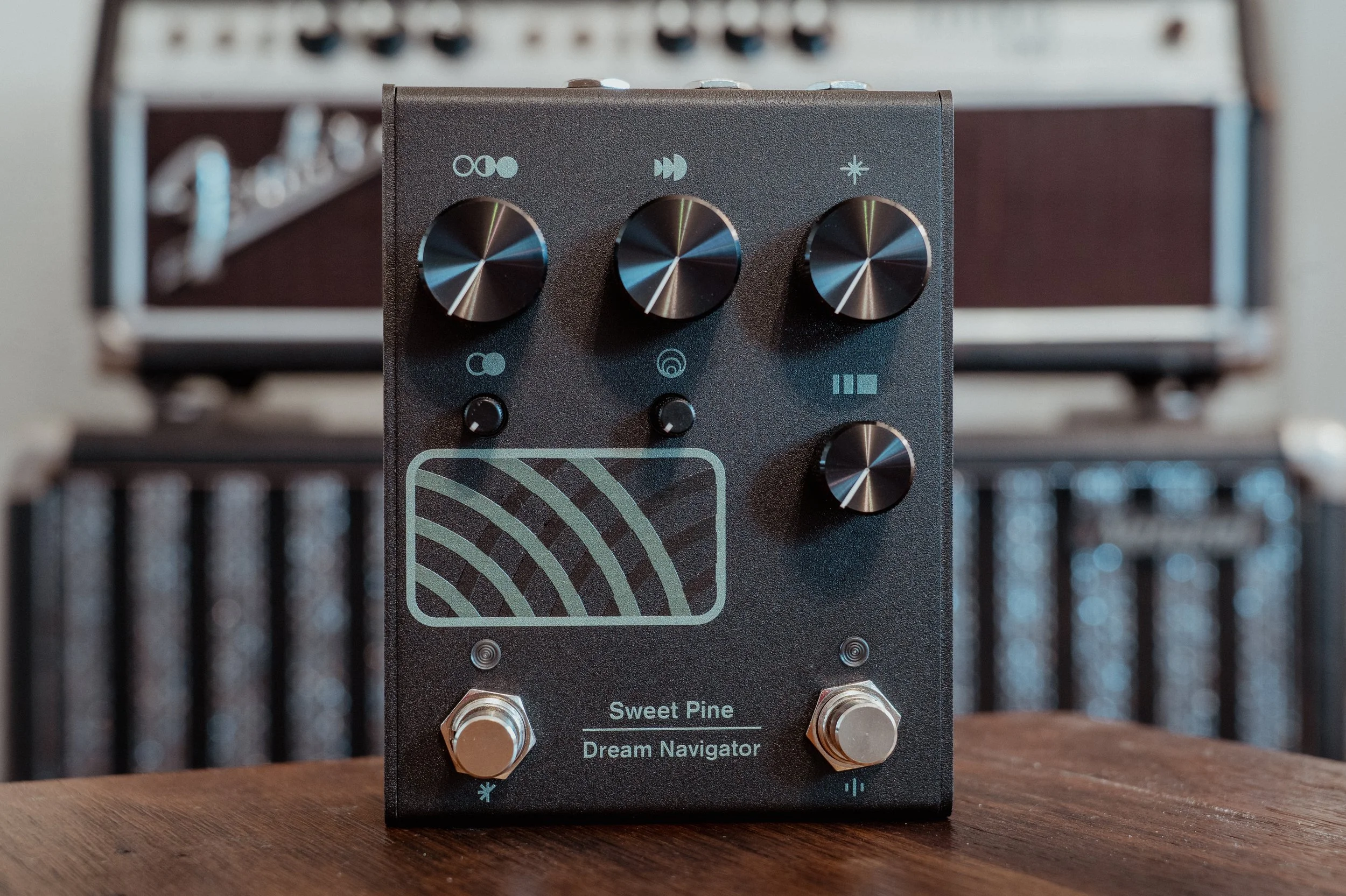
Dynamic Loop: Sweet Pine waits for your next note, then plays the newest phrase until you play something new. No record button and no clock. It runs on your dynamics. Dig in and the memory starts over, lay back and it keeps going, stop playing and your last note carries on until you play again. In stereo, every memory lands in its own place, so the loop surrounds you instead of stacking up in the middle.
Fragments: How much of a memory comes back. Fully left is a stutter, 70 to 140 ms, and fully right is the whole phrase, 300 to 1000 ms. Short pieces scatter, long ones surround you.
Voices: Which octave the memories come back in. Fully left is an octave down, where they sit low and give the ambience its body. Fully right is an octave up, brighter and sharper, jumping in and out. Noon is your own octave, and anywhere in between mixes the two sides, leaning harder the closer you turn to an end. A tone control, but for octaves.
Dream:How deep into the dream you go. Left is a small, close room with the memories sitting right in front of you. Turn it up and the room keeps growing, the decay stretches out, a low cut rises so the wash stays clear, and past noon the tail starts to drift in pitch. All the way up, the memories dissolve into a near-infinite, modulating tail that never holds still.
Sustain: How long the memories hang before the reverb takes them. Fully left they pass straight through. Turn it up for 5 to 500 ms of echo, and each one repeats and lingers, with a light tape wobble on top and feedback that builds with the time but never runs away.
Infinite Loop: When you hear a memory you want to keep, Sweet Pine holds it. It stays, looping under everything you play next, inside the same reverb, so the pad and your live instrument sit in one space instead of the loop killing your reverb. Fragments, Voices and Sustain keep working on the held memory, so you build textures in real time and reshape them as you go.
Deep Control: Plug in an expression pedal, or send MIDI CC to every knob and both footswitches, to expand what Sweet Pine can do.
Sound Clips
Here's how Blackfeet tradition shaped the engineering.
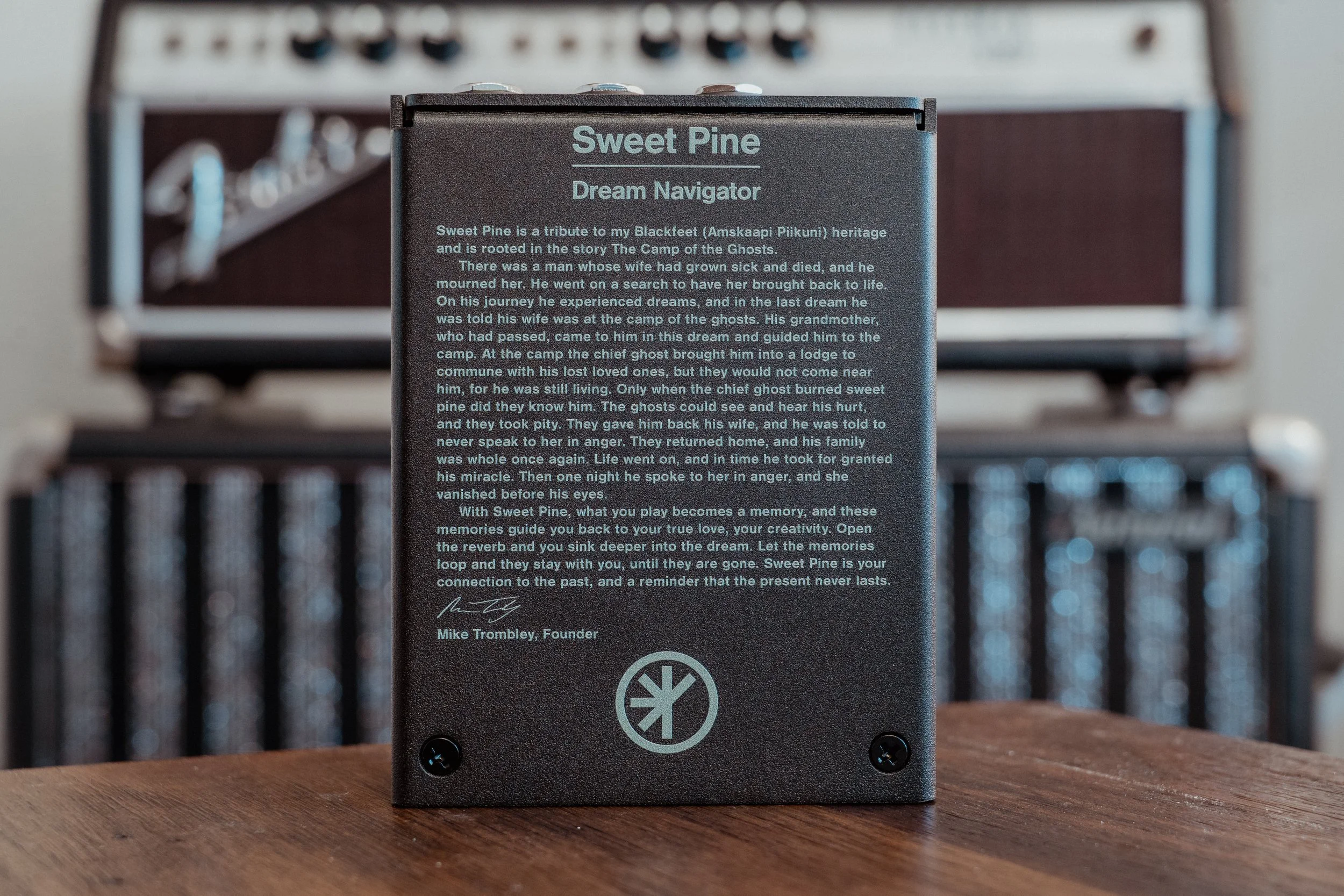
Sweet Pine is a tribute to my Blackfeet (Amskaapi Piikuni) heritage and is rooted in the story The Camp of the Ghosts. Tradition tells the story of a man whose wife passed and his journey to bring her back. On that journey, exhaustion leaves him in a dream, where he finds his way to a place called the camp of the ghosts. There he meets the chief ghost, who burns sweet pine so he can be reunited with his wife. As they leave the camp, he is told to never speak to her in anger. Time passes, and he takes his miracle for granted by speaking to her in anger. In that moment, she vanishes.
Building on In the Water, our Wave Reflector, we wanted to expand on waveform generation and open the musician up to something more complex. Where In the Water took a single note and grew it into a full synth-like texture, Sweet Pine takes melodies and chords and lets you twist and turn them into wide, expansive ambience. The story's dreams and memories gave us the structure. The always-repeating loops are the memories, shaped by octave generation and granular-like playback into the backbone of the soundscape. Dynamic mode samples what you play in real time and infinite mode holds it endlessly, and both feed a flexible reverb, the dream, with multi-parameter controls that carry you anywhere from a small room to an endless space. Together they let you build polyphonic ambient textures and connect with them inside the dream.
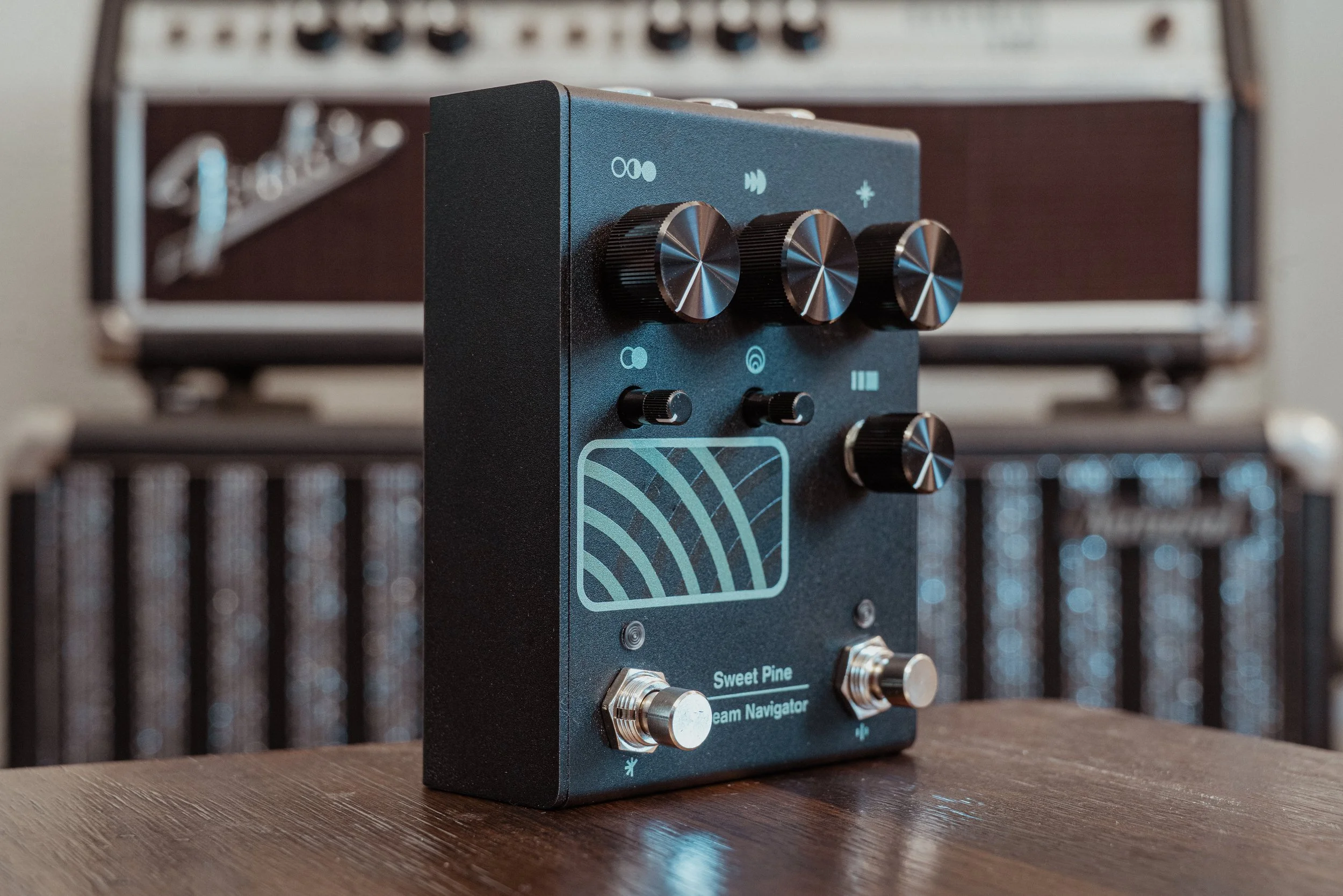
Sweet Pine's design carries two sets of repeating curves. They are pine needles, a tribute to the turning point in the story, when the sweet pine burned and he was reunited with his love, and they are also waveforms echoing out into an endless space. One set sits light and up front. The other is darker and fading into the distance, a memory that was here and is now gone.
Flip it over and you'll see the full story of why Sweet Pine exists and how my Blackfeet heritage shaped it.
You're not buying a pedal. You're joining musicians who see their pedalboards as expressions of their values and their sound. We believe the tools we use to create should carry the same intention and meaning as the music we make.
That's how we keep Blackfeet culture alive. Not behind glass, but in action.
Here's what it sounds like in action.
Specifications
- Version: v1.0
- Circuit: Analog Dry, Digital Effect
- Output: Stereo
- Bypass Switching: Buffered Bypass
- Switching Method: Momentary and Latching
- MIDI: 1/4" TRS, Type A
- Power Supply: 9VDC, 225mA (center negative)
- Dimensions: 3.7" x 4.8" (W x L)